

Disclaimer: This resource has been provided courtesy of National Council of Nonprofits.
Navigating This Uncertain Moment
This document provides guidance and messaging for nonprofits navigating ongoing attacks on our community. This includes the rising threats to 501(c)(3) status, politically motivated investigations, and harmful rhetoric that falsely associates nonprofits with violence. Together, we are united in our fight to protect the vital work nonprofits do in communities across America every day.
Evergreen Talking Points
If asked by a reporter or community member for your reaction to the current state of affairs, first pivot to core points about what makes nonprofits essential for all Americans:
• Nonprofits show up every day, doing the invisible work no one else does in both rural communities and urban neighborhoods across America.
• They show up in tough times—providing disaster relief, crisis support, and safety from danger. And they show up for the everyday needs, too—from childcare and elder care to job training and essential food and shelter.
• Nonprofits do all this through mostly very small, very well-managed organizations that know how to make every dollar count. They have local leaders who understand local needs, and they work hard to make their neighbors’ lives better.
• Whenever possible, include an anecdote about how your organization strengthens your community.
Responding to Attacks on Nonprofits in the Wake of Political Violence If asked to comment on efforts to undermine the credibility of nonprofits, you may follow this framework:
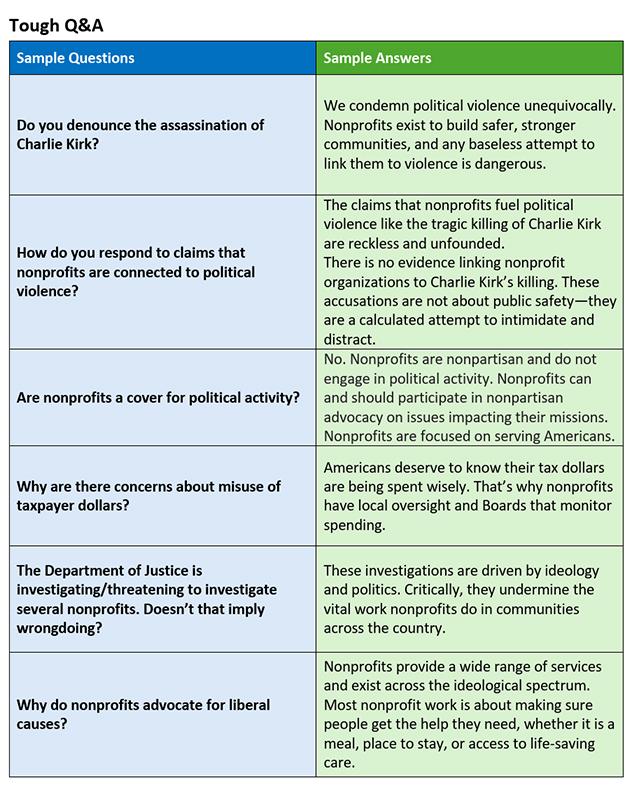
• [Your Organization] condemns political violence unequivocally. Nonprofits exist to build safer, stronger communities, and any baseless attempt to link them to violence is dangerous.
• There is no evidence linking nonprofit organizations to Charlie Kirk’s killing. These accusations are not about public safety—they are a calculated attempt to intimidate and distract. This is censorship masquerading as protection.
• In times of grief, our nation needs steady leadership that brings people together, not reckless accusations that tear us further apart.
• This rhetoric puts staff, volunteers, and communities at risk. Words matter, and irresponsible accusations create fear among staff, discourage volunteers, and undermine donor confidence. Most importantly, this language threatens the continuity of services that millions of Americans rely on, from after-school programs to emergency food assistance.
• Nonprofits are the backbone of American civil society. They connect neighbors to safe shelter, nutritious meals, and vital healthcare.
• Nonprofits are nonpartisan. 501(c)(3)s exist to serve and strengthen communities by providing meals, shelter, healthcare, community revitalization and enrichment, and more—not to engage in partisan politics or violence.
• Nonprofits must be free to fulfill their missions without fear, harassment, or retribution, regardless of who is in power.
• We call on leaders from all parties and all branches of government to condemn false and dangerous rhetoric, to stand up for nonprofits, and to reaffirm that civil society must be free from harassment and intimidation.
Responding to Ongoing Attacks on Nonprofits
If asked to comment on ongoing federal or state investigations—or threats of investigations—into nonprofits, keep it general and redirect back to our core talking points.
• These threats are not grounded in evidence of wrongdoing. They distract from the real work nonprofits do every day to serve their neighbors.
• Investigations without evidence harm staff, volunteers, and donors by redirecting nonprofits’ two most valuable resources—time and funding—away from their core mission, helping Americans. • Even threats of investigation sow fear and doubt, ultimately jeopardizing services that families rely on. • Nonprofits, which provide critical and often life-saving support, should be protected and encouraged— not subjected to intimidation tactics by the federal government.
Message Guidance
• Stay calm, nonpartisan, and mission oriented.
• Keep responses fact-based and counter false claims with evidence and clarity; avoid exaggeration or speculative language. Avoid repeating the negative.
• Use trusted validators like faith leaders, local friends, and neighbors. Whenever possible, consider these messengers as third-party validators. NCN polling found that 51% of Republicans trust church or faith leaders to provide them with information about nonprofits. Your message is more powerful coming from someone your audience already trusts.
• Stress humility and service. Most Americans see nonprofits as quietly serving communities—with 73% of Republicans agreeing that nonprofits “go about their work quietly, focused on supporting the most vulnerable and responding in times of crisis.” Lean into that trusted reputation.
• Stay forward-looking; highlight solutions, unity, and the essential role nonprofits play in strengthening democracy and communities.
• Always bring it back to communities and impact. Use local examples and tell stories of neighbors helping neighbors. Every attack on nonprofits is an attack on the meals, shelter beds, clinic visits, and community programs people depend on.
General Crisis Communications Counsel
Below, please find generalized crisis communications guidance in the event of a potential risk to the reputation of the organization. For greater assistance, please contact the National Council of Nonprofits.
Preventing a Threat
• Ensure you are reviewing all decisions, actions, and documents through a political lens to identify what, if anything, could be taken out of context.
• Review language on all externally facing documents to ensure awareness.
• Develop a process for vetting contributions and donors.
• Lock personal social media and ensure all staff understand the organization’s social media policies. • Develop a crisis plan, decision tree, and messaging to be able to expedite responses. • Develop difficult Q/A to address questions that could contribute to a sensationalized media environment (i.e., salaries, recent grant making).
Neutralizing a Threat
• Speed is critical.
• Utilize crisis plan and decision tree.
• Set up media and social media monitoring systems.
• Ensure board members and other key stakeholders are aware of the potential for heightened media and activist attention.
• Provide messaging support to board members, key stakeholders and staff
• Reinforce that only designated individuals are authorized to respond to the media.